Episode 24: Cheap ePhoto LED Panel Review

July 26, 2011

in Gear,Lighting,Podcast Episodes,Reviews

I have been super impressed with this LED panel. Here are some of my thoughts:

  • Daylight Balanced – If you have Tungsten (3200K) lights you will need to convert them to daylight or visa-versa.
  • Small – These will be awesome for traveling.
  • Dimmer – Great feature for getting the luminance perfect.
  • Battery – If you can get the battery version I would.
  • Light Power – I have the 600 version, seems a wee bit weak for anything other than 1 person interviews etc. You might want to consider getting a 900 or 1200.
Here is the breakdown of the different Models:
_______________________________________________________________________________________
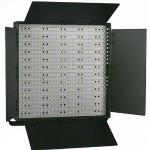
The ePhoto 600 is the Smallest size panel in the series. I found it makes for a great 1 subject light or background light to support larger lights.

  • 600LED, 14.8V DC power, Voltage: 110V-230V
  • 5400K LED color temperature, with 3 gels
  • Size: 12″ x 12″ x 2″ Weights: 5lbs
_______________________________________________________________________________________
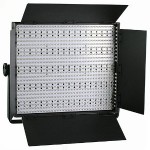
The ePhoto 900 is the second highest powered LED in the light series. I found this to be the best model to by first if you are getting started with LED lights.
  • 1200 LED, 24V DC power, Voltage: 110V-230V
  • 5400K LED color temperature, with 3 gels
  • Light intensity: 1m :9500 lux, 2m :3300 lux 3m :1600 lux
  • Size: 16″ x 12″ x 2″ Weights: 6.5lbs
_______________________________________________________________________________________
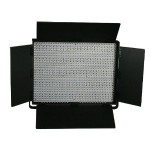
The ePhoto 1200 is the most powerful of the LED series and makes for a great indoor key light or outdoor fill.
  • 1200 LED, 24V DC power, Voltage: 110V-230V
  • 5400K LED color temperature, with 3 gels
  • Light intensity: 1m :9500 lux, 2m :3300 lux 3m :1600 lux
  • Size: 16″ x 12″ x 2″ Weights: 6.5lbs
You can find a bag for these lights here.

_______________________________________________________________________________________

Quicktime File: DSLR Video Shooter Episode #024

  • http://www.facebook.com/people/Paul-Lewis/1698139226 Paul Lewis

    Great Review. I might be picking up a few of those smaller LED panels for indoor fill lights and stuff, glad you and cheesycam showed me these.

  • Pingback: DSLRVideoShooter.com – LED Light Panel Review » CheesyCam

  • http://www.anticipatemedia.com Paul

    Caleb thanks for the great review. It’s great that you share your experiences with people. You’ve also saved me some time with my own review, as I can now just send people to your site for background. ;) I own these lights (the 600 LEDs) and have a few things to add.

    1) The 600LEDs are plenty bright if not overbright when shooting on the Sony FS100 and F3. With the light at full blast and 5 feet from someone, it overpowers the FS100 at 0DB and I’d need ND to even shoot with it that way! I had best results with the lights turned down to 1/3 power.

    My 60D needed to be at ISO1600 to get the same result, so obviously this is a camera thing. But the take away is if you have a sensitive camera such as the FS100 or F3, the 600LEDs are more than powerful enough, even at a distance.

    2) These lights are on sale on Amazon as ePhoto for $350 as you note. They also are on sale on Amazon as “Neewer 600 LED” lights for a lot less – I believe I paid $270 per light and if you buy them in sets they are even cheaper. I accidentally purchased the ePhoto lights as well so I was able to compare them; the lights are literally identica – made by I believe Guang Hung Electronics in China (that’s their “G” logo on the filter portfolio.)

    The cheaper yet identical lights also come with the remote dimmer, which is a plus if you have the lights on a boom or whatever and hard to reach the controls.

    3) That minus green filter is a virtual requirement. Me and Ben Eckestein separately tested the lights and they have a huge green spike in them, which can cause someone’s skin to look completely unnatural. (The far more expensive LitePanels have the filter built into the LED apparently, and it showed.) I haven’t done extensive testing with the included minus green filter; it may be enough or more may be needed. My guess is another 1/8th minus green on top (for 1/4 minus green) will be the ticket, then you balance your camera on that.

    Overall, I love the lights. For the cost you can get 4 of them with dimmers for the price of one LitePanel 1x1s. I threw them in a Pelican 0340 cube case and with care I think they will last. But one has to be careful to gel them properly, buy bigger (as you recommend) OR use a sensitive camera, and note that they can be found cheaper if you look around.

  • http://dslrvideoshooter.com calebpike

    I will have to check out those other ones. I don’t know about you, but I do a lot of bounce/scrim diffusion when I light (cuz softer is sexier) and of course this cuts down on light output. And not all of us can afford/use F3s or FS100s ;)

  • http://www.anticipatemedia.com Paul

    haha I do too, and you still have plenty of light for the hyper-sensitive F3/FS100. But yeah I hear you on the costs; the 600 LED especially diffused is not as bright as I’d like when shooting say, a Canon 60D SLR at it.

  • Sjschall

    Thanks for the review. We’ve been looking at different lighting options and these seem really cool. Loving the hidden feature at the end :)

  • Michael Morlan

    Ah. It’s good to see these Chinese OEM instruments hitting the market.  I reviewed the offerings from Shantou Nanguang along with every LED panel on the NAB 2011 show floor. 

    BRIGHTNESS:

    Very unofficially, I metered the CN-900HS at 500fc at 5.5ft.  That is the length of my arms – my official measure on the show floor.  ;-)   Compare that to the Lightpanels 1×1 SuperSpot (similar to the CN-600HS) which delivers 190fc at 5.5ft.  (I did the best I could to snoot my meter at NAB but am sure to have received some spill from adjacent instruments and the room so consider that reading a little high.)

    There are no photometrics from Shantou or the OEM distributors.  This is a critical metric for my evaluation of instruments.  Caleb, I’d be interested in your meter readings for your instruments.  Also of interest would be the spread in degrees (measured as the degrees from center with a meter reading of 50% of the center reading.)

    COLOR RENDITION:

    Traditional color meters like my Minolta Color Meter II cannot read LED sources.  To get a gander at color at NAB, I used my Canon SD990IS point-and-shoot on manual settings.  Set at “daylight”, I could see what color cast each instrument suffered.

    The CN-600HS definitely has a green spike that is managed with -green filters as others have noted here.  Interestingly, Litepanels secretly keeps hard minus-green filters that you must ask for.  you can’t order them on their website.

    Despite LED binning (selecting from the best from those delivered by LED manufacturers) different LED types display widely varying color character. (a spot LED vs. a flood LED.)  Litepanels instruments are all over the place with their CRI and color spikes.  For example, I could ascertain, by eye, a significant difference between the spot and flood banks of LED’s of the Litepanels Bi-Focus instrument.

    My Litepanels Superspot shows good CRI with no discernable green spike according to my point-and-shoot.  I haven’t done an official test with my RED One MX but haven’t notice any spike in practical interview setups.

    BUILD QUALITY:

    pros:  Well done housing, controls, and battery/ac options.  The remote jack is also excellent.  Price.  Watch out LitePanels.

    cons: Replace the crappy TVMP adapter with something more robust.  It won’t last long.  Green spike must be managed by filters but at that price…

    Michael Morlan

  • Mikkel

    Great review … but no samples?

  • http://dslrvideoshooter.com calebpike

    Didn’t have time. Had an out of state project to go to and then my basement flooded :(

  • http://giuliosciorio.com Giulio Sciorio

    What are you doing to secure the power source? I just got two 1200′s and am probably going to use industrial velcro to adhere the power supply to the back.

    Excellent review.

  • http://dslrvideoshooter.com calebpike

    somethings like that yes.